Problem
Solving quantum eigenvalue problems analytically is only possible for a few idealized potentials. For realistic systems, efficient and accurate numerical methods are needed — but the trade-offs between accuracy, grid resolution, and computational cost aren't always clear from theory alone.
Solution
Implemented 2nd and 4th-order finite-difference discretizations of the 1D Schrödinger equation, assembled sparse Hamiltonian matrices, and solved for eigenvalues/eigenstates using ARPACK. Ran convergence studies comparing stencil orders, validated against analytical solutions, and produced publication-ready figures.
What I Did
-
Built core numerical modules for grid construction and Hamiltonian assembly using 2nd and 4th-order finite-difference stencils, leveraging sparse matrices for efficiency.
-
Implemented eigenvalue analysis tools with analytical reference solutions, numerical solvers (ARPACK via
scipy.sparse.linalg), error analysis, and convergence helpers. -
Ran convergence studies comparing 2nd vs 4th-order accuracy on infinite square well (ISW) and quantum simple harmonic oscillator (QSHO) systems, verifying expected convergence rates.
-
Validated against analytical solutions for the infinite square well and harmonic oscillator, confirming eigenvalue accuracy and eigenfunction node counts.
-
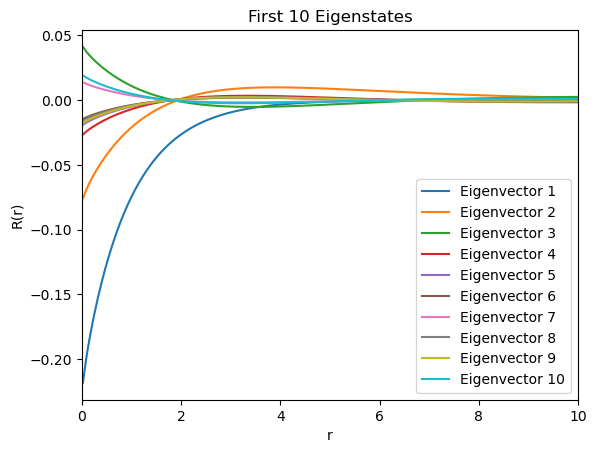
Generated publication-ready figures including convergence curves, eigenstate plots, and analytical-vs-numerical comparisons for the written thesis.
-
Wrote a full senior thesis document presenting the mathematical framework, numerical methods, results, and analysis.
Key Results
- 4th-order stencils achieved significantly better accuracy per grid point compared to 2nd-order, with clear convergence confirmed on log-log plots.
- Eigenvalues matched analytical solutions to high precision at moderate grid sizes.
- Sparse matrix methods kept computation efficient even at fine grid resolutions.
Thesis Document
The full written thesis is available in the GitHub repository.